The First Female Director of the Centraal Museum

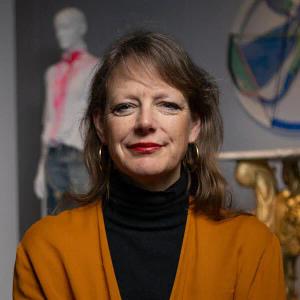
Meet Jonkvrouw Carla de Jonge, 'the best-dressed woman in Utrecht'.
“Far beyond the boundaries of the city of Utrecht, and far beyond those of our country, the expertise and tireless care that Lady de Jonge devoted to her exhibitions were invariably praised in the highest terms.”
Lady Carla de Jonge: a name that still echoes through our collection and the galleries of the Centraal Museum. Who was she, and what drove this remarkable woman? And what legacy did she leave us? In this article, I, Ninke Bloemberg, Curator of Fashion, highlight several key aspects of her long career, which unfolded at a time when it was far from common for women to attend university and earn a doctorate. She even managed to become the Centraal Museum’s first female director, making her one of the first women in the Netherlands to hold such a position. She also laid the foundations for the museum’s important fashion collection and built an impressive track record in research, publications, acquisitions and exhibitions. She established a permanent costume display at the museum that remained in place for decades. Today, it has returned as part of the permanent presentation, Collectie Centraal.
The Dress Code gallery in Collection Centraal, 2023.
The first steps in her career
Jonkheer Caroline (Carla) de Jonge was born in Dordrecht in 1886 and grew up in an aristocratic family. She had an older brother and sister. Her father died when she was four years old. In 1894, her mother moved with the children to The Hague. There, De Jonge attended the Gymnasium Haganum, where she skipped the sixth year and took the state examination in 1904. That same year, De Jonge began studying Dutch language and literature in Leiden—at the time, art history was not yet a separate major.
A year after obtaining her master’s degree in 1912, she became an assistant in Utrecht to Professor Willem Vogelsang, the first professor of art history in the Netherlands. Among other things, Carla de Jonge was involved in organizing an exhibition on painting and sculpture from the Northern Netherlands before 1575. He also passed on to her his enthusiasm for the history of costume, and she attended Vogelsang’s special lectures on men’s clothing in the fourteenth and fifteenth centuries. Inspired by this, she continued exploring the subject in her doctoral research. In 1916, she was awarded her doctorate cum laude for her dissertation Contribution to the Study of the History of Costume in the Northern Netherlands in the First Half of the Sixteenth Century: Men’s Clothing. Following the example of her doctoral supervisor, Vogelsang, she illustrated the dissertation with her own sketches.
Dissertation cover and illustrations created by De Jonge.
From civil servant to director
In 1917, Jonkvrouw de Jonge entered the service of the municipality of Utrecht, which at the time was still responsible for the city museum. Initially, she worked on the city’s public collection. At that point, the archive and museum had not yet been separated, and the collections were scattered throughout the city. On 1 August 1921, the ‘centralised museum’ (hence the name Centraal Museum) opened in the former St Agnes Convent. De Jonge set to work at the Centraal Museum with great energy: from 1921 to 1941 as curator, and subsequently as director. She held that position until the end of her career in 1951. She successfully championed a wide range of disciplines, including Old Master art and decorative arts. She devoted less attention to modern art. Her vision of bringing schools into the museum was innovative: ‘The Museum must be part of cultural education; it must be there for young people.’
The young noblewoman, as she liked to be addressed, had an extensive network and a broad interest in various art forms. She enriched the museum with no fewer than 27 works by sixteenth- and seventeenth-century painters, including Jan van Scorel’s famous Lokhorst Triptych, still one of the highlights of the collection.
She also published on the talented silversmiths Jan and Adam van Vianen, putting these important Utrecht makers on the (international) map. These are just a few examples that demonstrate De Jonge’s versatility. Her true passion, however, was fashion. In her dissertation, she writes: ‘Fashion must always be understood as a reflection of its time, speaking to us in its own language as one of the manifestations of cultural history.’ In this way, she was an early advocate for fashion as an art form in its own right.
A passion for fashion
‘Surely it is always much nicer to see old costumes properly displayed in a museum than to have them lie completely forgotten in a camphor chest,’ the young noblewoman wrote to Baroness Taets Van Amerongen. Proactively and persuasively, she approached her affluent network, gradually building an important fashion collection. Her interest in clothing was also clearly reflected in her own elegant appearance. She was sometimes called ‘the best-dressed woman in Utrecht’.
At first, De Jonge mainly collected historical items for the museum, but gradually she also developed an eye for garments and accessories from her own time. In the 1930s, for example, she acquired dresses from the ‘Roaring Twenties’.
Evening dress, c. 1926. Inv. no. 8227
Evening Dress Detail
Take this evening dress, with its turquoise beads set against sheer crêpe georgette. The dress consists of two layers, except at the shoulders and neckline, which are covered by just a single layer of crêpe. Its hemline, falling just below the knee, marked a radical break with established conventions: for the first time in fashion history, women’s calves were visible.
On contemporary fashion, De Jonge wrote in 1941:
“No generation will ever consider itself eccentrically dressed. One should never forget that young girls and elegant young women can do their part to create a new fashion, […] one that by no means everyone can carry off.”
The historical gown on display at Collectie Centraal (2023).
Historical gown
Most of the collection, however, consisted of historical garments. ‘Even without having seen the gown, I gratefully accept this offer…’, wrote Jonkvrouw de Jonge to Miss Verploegh when she offered the museum a gown in 1937. By accepting it sight unseen, the young noblewoman acquired a unique piece. To this day, it remains one of the oldest signed gowns in the museum’s collection.
Following the example of Charles Frederick Worth, the founder of haute couture, gowns were increasingly signed by their maker—or, in this case, their female maker—from the early 1860s onwards. This gown was made by Marie Joséphine Divoire-Bawin (1822–1883), a couturière with a studio at 20 Hofbergstraat in Brussels. Between 1870 and 1880, the fashion house had a significant Dutch clientele that included noblewomen and ladies-in-waiting.
Rooms full of costumes
Thanks to De Jonge’s efforts, gaps in the fashion collection were filled. This was done not only for preservation, but above all for display. She was a pioneer in this field, seeking to showcase the gradual development of costume and fashion history while adopting innovative approaches.
From the museum’s earliest beginnings (founded in 1838), the first garments were displayed under the category of ‘household effects’. They had belonged to prominent Utrecht residents or had been worn during important events. They fitted well with the museum’s aim of showcasing both the history of Utrecht and the artistic developments that had taken place in the city. One of the earliest references to costumes on display can be found in the 1906 Guide to the Municipal Museum of Antiquities, which includes a photograph of a ‘kitchen cupboard’ filled with garments, bonnet-style hats and fans.
Image from Guide by the Municipal Museum of Antiquities, 1906.
Green silk damask
According to the guide, the showpiece was the handsome coat of green silk damask, traditionally said to have been a bridegroom’s attire and donated to the museum by Mrs VerLoren van Termaat, née De Pesters.’ A distinctive feature of this close-fitting late-18th-century coat is its sewn-in waistcoat made from the same fabric. The pattern of the green fabric consists of winding branches with large flowers, leaves and pomegranates.
So the young noblewoman did not have to start ‘from scratch’, although the number of fashion objects could more or less be counted on two hands. At the time of her appointment, the collection was housed in the Het Hoogeland villa. In 1921, the museum moved into its current premises on Agnietenstraat. Only then could she truly begin building the collection.
Display cases full of costumes on Agnietenstraat.
At the beginning of the twentieth century, the aim was to display as much of the collection as possible. New acquisitions went straight on display. In the new thematically arranged museum galleries, De Jonge set aside space for costumes, which was quite unusual at the time. It began with a single display case, but before long the presentation had expanded to eight (full) cases, filling two galleries with an overview of fashion from 1750 to 1900. Later, this grew to as many as three galleries. Photographs show that direct daylight entered the galleries from above.
‘The Costume of Our Ancestors’
That the young noblewoman had a keen sense of what the public wanted is evident from one of her greatest achievements: the exhibition The Costumes of Our Ancestors. It was held in 1936 in the Ridderzaal in The Hague and featured ‘tableaux’ from different historical periods. The Centraal Museum lent five gowns for the occasion. The exhibition was a great success and attracted thousands of visitors. De Jonge also served as the ‘lady speaker’ at the historical fashion shows she organised, which proved extremely popular.
The exhibition travelled around the country, from The Hague to Amsterdam, Arnhem and Rotterdam. Het Vaderland – political and literary newspaper reported on 27 September 1936 that the Amsterdam edition was expecting its 5,000th visitor—a woman who received an antique silver candlestick. It continued: ‘On Friday evening, amid great interest, the exhibition “The Costume of Our Ancestors” at Trianon in Amsterdam held its second fashion-show evening. […] Only two more fashion-show evenings will follow.’ Jonkvrouw de Jonge also produced the catalogue for this exhibition, which covered the period from 1750 to 1915. The initiative gave a major boost to the study of costume history in the Netherlands and subsequently enriched the country’s various fashion collections through loans and donations. De Jonge even wrote to the curator of the Open Air Museum in Arnhem that ‘as a result of the exhibition “The Costume of Our Ancestors”, so very much has been offered to the Centraal Museum that I cannot possibly accept everything’.
First female director
As early as 1921, De Jonge was the ‘backbone of the museum’ behind the scenes in matters of policy, acquisitions and day-to-day management. On 2 January 1941, the city council appointed ‘the curator, Jvr. Dr C. de Jonge, as director of the Centraal Museum in Utrecht.’ She remained in the post until her retirement on 1 April 1951, becoming the museum’s first female director and the third woman to hold this position at a Dutch museum. In her new role, she was able to chart her own independent course. The first few years were turbulent: during the occupation, she had to safeguard the collection and keep the museum running. Part of the museum reopened to the public on 30 July 1945. On 1 December, the eight period rooms reopened, along with a reorganised costume department and six galleries of modern art.
Carla de Jonge (middle row, second from left) with a group, 1913.
In her final years as director, De Jonge did everything she could to keep the museum accessible, relevant and vibrant through exhibitions, publications, concerts and lectures. She developed a modern museum policy in which education played an important role. On her departure from the museum, it was recalled: ‘It was her successful idea to furnish several rooms in the museum building as historical period rooms, and she organised a great many exceptionally successful exhibitions.’ ( Algemeen Handelsblad, 11 January 1951). Another newspaper wrote: ‘Far beyond the boundaries of the city of Utrecht and far beyond those of our country, the expertise and tireless care that Miss De Jonge devoted to her exhibitions were invariably praised in the highest terms.’ ( Utrechts Katholiek Dagblad, 12 January 1951).
She had no intention of sitting idle after her retirement: ‘She did not view this farewell as tragic, because she hoped it would give her the peace and quiet to pursue scholarly work. For her, the museum will never reach saturation point.’ ( Nieuw Utrechtsch Dagblad, 2 April 1951). As a retirement gift, her friends gave her a stay in Rome. After retiring, she travelled more and became active in the international world of costume history. Among other things, she contributed to an exhibition on silk at Palazzo Grassi in Venice in 1952. She died in The Hague in 1972.
Exhibition Out of Fashion, 2017.
Looking ahead by looking back
Thanks in part to De Jonge’s contacts in the highest circles, the Centraal Museum’s collection grew steadily: from a few garments and fragments to several hundred objects. It was to her credit that a solid foundation was laid for a costume collection. Subsequent generations of curators were then able to add depth, forge connections and introduce new emphases, making the fashion collection internationally significant today.
She herself did not dwell so much on the milestones she achieved as a woman, but focused primarily on the ‘art-historical insights’. It was no coincidence that in 2017 the Centraal Museum organised the exhibition Out of Fashion, which was intended in part as a tribute to her.
Masculine elegance
Several of her acquisitions can be admired in Collectie Centraal. Since December 2023, fashion has had a permanent home again for the first time since 1978: the DRESSCODE gallery in Collectie Centraal. The fashion items in this display are changed every six months due to the fragility of textiles. Several garments acquired by De Jonge are currently back on display, including the red-and-pink habit à la Française dating from around 1760–1770: the height of masculine elegance. Carla de Jonge was so taken with this suit that, after the well-attended exhibition Het Costuum onzer Voorouders, she took the plunge. She asked the owner, Dowager Cornelie Jeanne Heemskerck van Beest-van Reede tot Ter Aa, to lend her the garment.
The young noblewoman wrote to the dowager: ‘The costume in your possession, which, on account of its fine cut and fabric and the perfect condition in which it has been preserved […], has always filled me with the desire that it might find a place in the Utrecht museum. I know that the museum in The Hague also had its eye on it, but I convinced Dr Van Gelder that my request deserved precedence in this matter, all the more so because your family had ties with Utrecht.’ Her request was successful.
More than a hundred years later, the young noblewoman’s approach and vision continue to inspire. As of 2024, the museum is responsible for some 10,000 fashion designs and focuses more on experimental and innovative fashion.
Carla de Jonge sitting outside on a chair.
Exhibitions
Sources consulted
Hanneke Adriaans, '“Zoo menig japon als cultuurhistorisch document”, de geschiedenis van de kostuumafdeling van het Centraal Museum Utrecht', in: Margaret Breukink-Peeze, Kostuum verzamelingen in beweging: twaalf studies over kostuumverzamelingen in Nederland en inventarisatie van het kostuumbezit in Nederlandse openbare collecties (Zwolle 1995) p. 78-90.
Hanneke Adriaans, Saskia Kuus, De Verzamelingen van het Centraal Museum, Mode en kostuums (Utrecht, 1996) p. 13-33.
Ninke Bloemberg e.a. Uit de mode: collectie van het Centraal Museum (Utrecht, 2017), p 6-8, 72, 100.
Carla H. de Jonge, Het costuum onzer voorouders (tentoonstellingscatalogus, Den Haag 1936) p. 26.
Carla H. de Jonge, De costuum-verzameling 1750-1930, gids en catalogus (Utrecht, 1947) p. 5, 54.
Carla H. de Jonge, Een eeuw Nederlandse mode (Amsterdam, 1941).
Carla H. de Jonge, Bijdrage tot de kennis van de Noord-Nederlandse costuumgeschiedenis in de eerste helft van de zestiende eeuw. Deel I: mannencostuum (dissertatie, Utrecht, 1916).
Meta Knol, e.a. ‘Dromen en daden’, in: De Verzamelingen van het Centraal Museum, Beeldende Kunst 1850-2001 (Utrecht, 2001) p. 19, 21, 94, 117.
Yvette Marcus-De Groot, ‘Museumdirectrice van formaat’, in: Kunsthistorische vrouwen van weleer. De eerste generatie in Nederland vóór 1921 (Hilversum 2003) p. 274-297.
Ileen Montijn, 'Jonge, Caroline Henriette de', in: Digitaal Vrouwenlexicon van Nederland, https://resources.huygens.knaw.nl/vrouwenlexicon/ (5 januari 2018).
Bianca M. du Mortier, Mode & Kostuum, Rijksmuseum (Rotterdam 2016) p. 5-16.
Modemuze https://www.modemuze.nl/blog/uit-de-mode-de-inloopkast-van-het-museum
Marie-Cornélie Roodenburg, ‘Jonkvrouw dr. C.H. de Jonge, kunsthistorica (1886-1972)’, Mensen van vroeger. Maandblad voor genealogie 5 (1977) p. 1-15.