Seeing Through Different Eyes: Move You Fool
How do you create an exhibition that does not start with a fixed art-historical narrative, but with a different way of seeing?
For the exhibition Move You Fool artist Shertise Solano collaborated with curator Catrien Schreuder on an exhibition in which tarot is not about prediction, but reflection. Not as a fixed system, but as a starting point for pausing, looking more closely, and making new connections within the collection.
The first encounter
The collaboration between Schreuder and Solano did not begin in Utrecht, but earlier, at the Stedelijk Museum Schiedam. Shertise Solano had already exhibited there several times, including a video work in the 2022 exhibition Spirituele Urgentie. “That sparked our first conversations about what art means to her and what I consider important as an exhibition curator,” Schreuder explains. Even then, Solano spoke about her love of tarot and her desire to create new work inspired by the cards and connect it with the work of other artists.
When Schreuder later began working at the Centraal Museum, she reached out to Solano again. “The Centraal Museum has such a wonderfully broad collection, including many twentieth-century artists for whom I felt this approach would be particularly fitting, as their work was also informed by more esoteric or spiritual perspectives at the time. It seemed like a wonderful way to explore this together with Shertise.”
What appealed to Schreuder from the outset was not only the subject, but above all the way Solano spoke about it. “Tarot was unfamiliar to me. But when Shertise started talking about it, I was immediately interested.” That also had to do with her confidence in Solano as an artist. “Shertise trained as an actor here in Utrecht and already had an entire acting career behind her before deciding to focus on visual art. In visual art, she found the space to conduct research through her body, drawing on all the experience and knowledge she already carried with her. She truly has something to say, sees things from a slightly different perspective, and is invariably right.”
Initially, Schreuder mainly associated tarot with astrology, fortune-telling and the spiritual realm. It was not something she rejected, but neither was it something she spent much time thinking about. That is precisely why she was surprised by how many artists have drawn inspiration from it. “Shertise told me how many artists have been inspired by tarot. I had never really realised that before.” She mentions Niki de Saint Phalle and Salvador Dalí, among others, as well as Surrealists and contemporary artists. “Once I started paying attention to it and reading more about it, I realised that there are many more artists—and non-artists too—for whom tarot is an important source of inspiration.”
The history of tarot also proved richer and more complex than she had expected. “Its history, which dates back to the Middle Ages. The complexity of the visual language that has developed over the centuries.” Schreuder delved into reflective sources, came across a recent interest in tarot in the art world, and saw how different strands converged: from fashion houses to art-historical research. “Suddenly, I could no longer imagine how I had never noticed it before.”
Laying out the cards: the process behind the exhibition
Yet the heart of the process lay not in reading, but in doing. Solano took Schreuder to meet her tarot teacher, with whom they had a total of six sessions. Each session was different and tailored to the stage the exhibition had reached. The first focused mainly on getting acquainted with tarot and making an initial exploration of their collaboration. This was followed by conversations about the kind of exhibition they wanted to create, Solano’s artistic process, and the choices that had to be made along the way.
“We used the sessions themselves to find inspiration, test ideas, discuss doubts—you name it,” says Schreuder. “Working that way had a tremendous impact; it really helped us make decisions and think differently from how we normally would.” The actual work took place outside those sessions: Solano created new work, selections were made from the collection, and practical processes such as fundraising and education were underway at the same time. But the sessions did provide a recurring opportunity for focus and coordination.
Photos taken by Catrien Schreuder during a session.
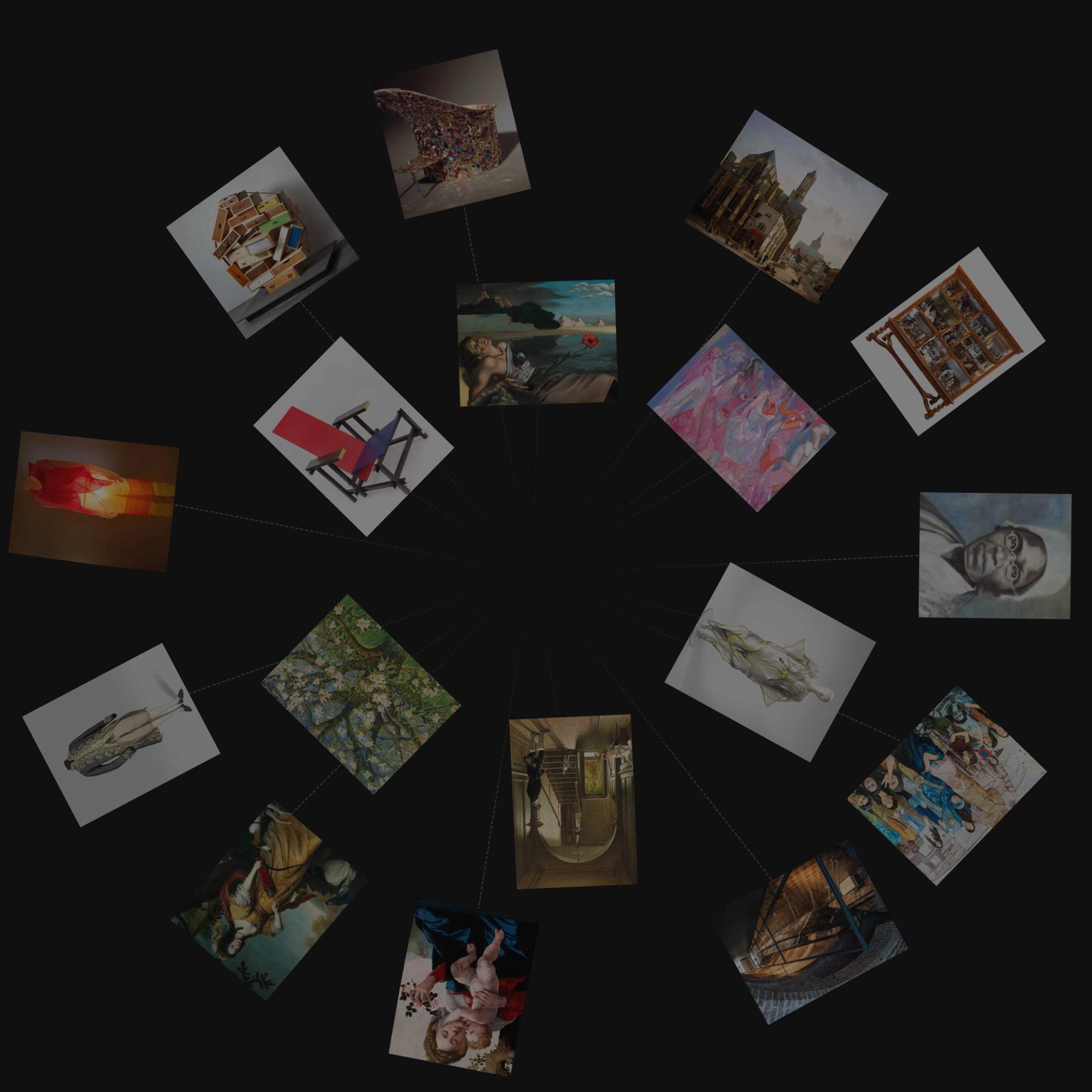
An important part of that process was selecting works from the collection. This was done in various ways. Schreuder herself began with artists from the early twentieth century whom she knew viewed life from a non-rational perspective and sought to depict “higher realities” in their work, such as Jacob Bendien and Jan van Deene. They are not known to have had a particular interest in tarot, but their work did engage with Buddhism, Theosophy and other schools of thought from that period.
Meanwhile, Solano delved deeply into the collection, looking for images that she associated with particular cards. Sometimes the connection was immediate. A lunar landscape, for example, could be linked to the Moon card. At other times, such a connection emerged through conversation. Schreuder cites the example of Erich Wichman: “a colourful and controversial figure who idolised fascism while also being a pioneer of modern art”. It quickly became clear to Solano that his work could be linked to The Devil. “Not as a judgement, but because the devil can set a great deal in motion, while also being driven partly by fear.”
In one of the sessions, they explicitly explored what happens when you look at a work of art with no prior knowledge, using a tarot card as your guide. Schreuder had brought prints of around twenty very different works, some already on their longlist and others not yet included. They took turns looking at a work and drawing a card to go with it. “It was great fun and quite remarkable, because it makes you really look, searching for clues that allow you to apply the meaning of the card to a work of art.” At the same time, it raised many questions about the artist, context and history. “So we realised that art-historical knowledge can still add a great deal, even in this format.”
For Schreuder, that is precisely where the power of tarot as a starting point for this exhibition lies. Not as a system that pins down meaning, but as a way of looking. “Like tarot, works of art have the ability to stir something within you. Sometimes you may recognise something in them—a feeling, a memory or an event.” In Move You Fool, visitors are therefore invited to open themselves up to the effect a work has on them. The emphasis is not on knowledge and understanding, but on contemplation and experience.
An in-depth program
This also ties in with the programme strand De Verdieping, in which the Centraal Museum continually invites new perspectives on its collection. “We deliberately choose co-curators who can offer a fresh point of view, who can bring genuinely new perspectives.” According to Schreuder, this exhibition emphatically does just that. Not because the museum should henceforth view art through the lens of tarot, but because tarot and other forms of meaning-making are indeed an important source for many people. “They are usually not represented. I think that’s a shame.”
For Schreuder herself, the process was meaningful both professionally and personally. She describes the exhibition as “a new approach” that requires “a certain amount of courage.” “You create it because you hope to make an impact, to create something positive. But because it’s a new approach, you can’t be entirely sure it will work out well.” That is precisely why, she says, it was sometimes tempting to opt for a safer format sooner. “But the tarot sessions really challenged me to keep asking questions: what do we want to achieve?”
Those sessions were about the exhibition, but they also touched on her personally. “I learned so much, including about myself.” She mentions cards she drew and assignments she was given. “I now know, for example, that I’m a Wheel of Fortune: always shifting, up for anything. I was told to follow through every now and then. To start sentences with: ‘I want’.”
What does she hope visitors will take away from their visit? Above all, that they take their time. “I hope visitors will fully embrace it, let the exhibition wash over them, and take their time.” Of course, there are texts and other resources, but according to Schreuder, this exhibition works best when you are willing to pause, notice how it affects you, and leave room for whatever arises. “Naturally, I hope people are moved by the artworks, both Shertise’s and those by the artists we selected.” Whether it is a work from a hundred years ago or a new piece by Solano, “each of them created their work with such craftsmanship, wisdom, and sincere intent.”
In Move You Fool, tarot is therefore neither a subject in its own right nor a promise of answers. It is a foundation, a first move, a way of looking with care. At art, at connections, and perhaps a little at yourself as well.